
Showing posts with label writing workshop. Show all posts

Wednesday, February 02, 2022

Reading, Writing, and...Weaving?

I spent the early part of January writing a decent synopsis for The Companion, sent it off to David Farland, who promptly had a stroke and passed away two days after I sent it. I'm pretty sure my manuscript wasn't the cause, but writers lost a good friend when he died. May he rest in peace.

Of course, I did what I always do when Death enters my life, even so obliquely: I read books. The two Nora Roberts books I'd read early in the month, the remaining six I dived into. I'll post the list below.
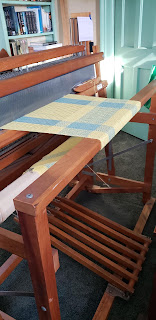
The loom set up
in my study
Long-time readers know I'm also a weaver, although I haven't had the loom out in over six years. More personal deaths and assorted events have taken up my time -- along with finishing a certain epic fantasy (I'm looking at you, Companion!). But there's been a project nagging at me for a while and I finally decided it was time. Got it set up, dressed it, and have been weaving a table runner for the sitting room. Wanted something for the spring. Something bright and cheery.

(If you look closely, you'll see my TBR shelves in the back. Yes, shelves. Four of them. Shelves, not books.)
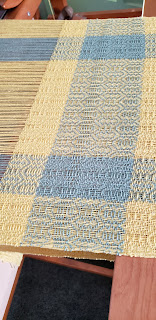
Jewel II pattern showing

For those of you who are also weavers: I'm using a 100% cotton thread (so this will shrink) with a 15-dent reed. The pattern is called "Jewel II" and is from Margaret Porter Davison's book A Handweavers Pattern Book. This was first printed in 1944 and contains hundreds of wonderful patterns for a 4-harness loom. 

This is a modified twill and does not use a tabby (one of the reasons I like it. Complicated treadling pattern already!)

And yes, I am still writing -- working on Volume II of The Companion. Playing around with actual titles (The Companion is my working title, not the definitive one) and will announce those when I finalize them.

Back in 2018, my hubby got me a book of writing prompts for Christmas. I started, as a 2019 New Year's Resolution, to take one each day and write from not only my personal perspective, but also from my protagonist's perspective. Basically interviewing my characters to see how they feel about things.

That lasted only a few days. Then my mom had a stroke and died two days later. I put it away in the crush of events (see above -- also put the loom away shortly thereafter as room was needed for other living) and pretty much forgot about it.

Well, I pulled it out when my characters stopped talking to me this month and have been writing nearly every day. There are two "new" characters in this volume (introduced in Volume I, play a bigger role in Volume II) and it's helped me to get to know them better. Planning to get to work on the actual story soon.

All right! My reading list for January! Short, only seven books long.

The Awakening and The Becoming by Nora Roberts (fantasy with some romantic elements; 1st two books in a three-part series. Looking forward to the next one!)
The Glass Ocean and Band of Sisters -- the first is an anthology of three authors, but Lauren Willig is one of them and she wrote Band of Sisters.
Sabriel, Lirael, and Abhorsen by Garth Nix (fantasy)

The first four are keepers -- they've already found room on my shelves. The Nix books I'm passing on to my daughter. I've read him before and enjoyed his work, but these just didn't pull me in as well. Might be my own frame of mind, though.

So that's my month, spent reading some, writing some and weaving some!

Play safe!

Diana


Friday, February 28, 2020

Writer's Block

It happens to all of us. We're going along just fine on a story -- the characters are talking, doing, reacting -- and then, BAM! They shut up. They freeze in position like a photograph in time. Everything screeches to a halt. Including you.

Writer's Block.

It happens so often, we've given it a name.

I don't get it often, but when I do -- I can sit on a story for years. Yes, you read that right. Years before I can get it to move again. The order in which books are released has nothing to do with the order in which they were begun.

I'm just coming off a several-year hiatus on my current work-in-progress (wip - an apt name for how I feel about it sometimes). The Companion is a book I started back in the '90's. I wrote several parts of it, changing the name of the main character, changing the setting, changing her attitude - but it wouldn't get off the ground. If I didn't like the story so much, I probably would've abandoned it all together, but the concept really had a hold of me.

But then I got published in the genre of erotic romance and I figured, "You don't want to cooperate? Fine, I'll go write something else."

So I did. Oh, I returned to it several times. Found a new place to start the story and wrote thousands of words on that draft. Even pitched it at a conference to an editor from Avon. She liked the concept enough to ask for the first three chapters (which I had) and a synopsis (which I didn't). I wrote the second and sent it off and she. quite rightfully, rejected it. It wasn't ready. I was still stuck on those early pieces I'd written, trying to work them in so I wouldn't have wasted my time.

Of course, that time wasn't wasted. I know the main character's backstory now and that informs much of what she's planning to do in the rest of the book. Perhaps someday those scenes will get published in a "deleted scenes" type book. That means, however, that I have to finish the main story.

Except that the characters of The Companion had stopped talking. I'd switched points of view (there are three main characters and switching between and among them helped move the story forward when I got stuck in the past. I'd ask myself, "Well, what does Kiera think about all this?" or I'd move to Martin's story and let him take the lead for a while.

That worked for a long time. For 145,000 words, in fact (about 450 pages). I played with format, I played with story arcs, I played with other parts of the story and each time I did, I managed to avoid getting stuck for too long a time. I'd leave one set of characters in their photograph and visit those who wanted to show me what was happening in their lives. Then, when they got tired and froze, I'd go back to the others and (usually) they'd be ready to talk.

And, to be honest, some of the writer's block is BIC problems. BIC = Butt In Chair. Having time dedicated to writing is part of it, but then again, the pressure is on to create. Creativity doesn't always come when you say, "Okay, I'm here. The computer file is open and I'm ready to go. Let's write!" So procrastination kicks in and I clean the house (see this post for more on that), I go grocery shopping, I scrapbook -- I have lots of procrastination tools. The key is not using them and forcing myself to stick my rump in the chair and write. Even if what I write is terrible. It can be fixed later. Just get words on paper.

Neil Gaiman, in his Masterclass, said, "You cannot fix a blank piece of paper," and that has become my mantra. Get the words down and fix them in the next draft. Taking several of the Masterclasses has helped me with the BIC and with the mental challenge of writing such a large story (this is an epic fantasy - and I'm about halfway through the first of what I suspect will be two books).

Yesterday, I went back to a tried-and-true method. I'd been stuck for several days. I knew what had to happen, but I couldn't figure out how to get to that point. I had snippets in my head but no string to hang them on.

So, I printed out the last two pages, pulled out a spiral notebook, made sure I had plenty of sharpened pencils, and got myself comfy in my overstuffed recliner and worked the old-fashioned way - in longhand. I teach my composition students that the brain works differently when holding a pen or pencil than it does when typing. Yesterday, I put that into practice - and wrote over a thousand good words before I was done for the day. Sometimes you just have to go old school.

So, have writer's block? Here are several ways to work around it:


  •    Set the story aside and work on something else. If it isn't working, stop beating your head against it. You'll only get a headache.
  •    Believe in your concept. That will prevent you from abandoning altogether.
  •    Try starting the story (or scene) in a different place or time. Take the character(s) someplace else and see what happens.
  •    Change the point of view. Either choose a different character or a different voice (switch from first to third person or vice-versa to get them talking again).
  •    Stick your Butt in Chair.. Get the words down, no matter how bad they are. That's what the next draft is for. Keep writing.
  •    Know your procrastination tools and don't give into them. They will lead you astray!
  •    Go old-fashioned and get out the paper and pen (or pencil). Use a different part of your brain.


So, go write!
Diana


Thursday, May 17, 2018

Killing your darlings

Since retiring from teaching full-time, I've been an adjunct instructor at our local community college. I love teaching there - especially at the satellite campuses where the students are (usually) non-traditional in their ages. What's especially exciting is that the college is instituting the Freshman Year Seminar - a class students take either their first or second semester that will help them transition to the more rigorous requirements of higher education. I am honored that I was asked to design and teach one of those seminars.

Each seminar has a different focus. The science seminars, for example, might be based on some of the more controversial aspects of science research or centered on science in today's media. I'm in the Humanities, so our topics/issues can be quite broad. I've chosen "The Memoir as Self-discovery" as the title to mine.

What does that mean? It means I've been reading a lot of memoirs lately! While the students will spend a great deal of time writing their own (topics such as "How I learn best" and "How I got that scar"), they will also read others' memoirs so we can discuss style, form, and content.

To that end, I finally read Stephen King's On Writing. I know, I know - it's taken me long enough. I've only read a few of his books because I don't do well with horror or suspense. Gives me oggeta (I have no idea how to spell that Italian word and neither does the spellchecker). I've enjoyed the few pieces I have read (The Green Mile, Eyes of the Dragon) and now I can add On Writing to the list. He's blunt, concise, and pretty much right on track.

I particularly enjoyed the section on killing your darlings.

In fact, that's twice in two weeks that phrase has popped up - once in class discussion of literature and then again in King's book. In class, I spoke of how hard it can be - and how necessary. It isn't easy, they are, after all, your darlings. You created that character, that scene, that sentence. It is a part of you. It may be the most beautiful piece of writing you've ever created. If it doesn't serve the story, however, it must die.

In class I spoke of a description I'd included in the first few pages of a VERY long fantasy novel (that will probably never leave my computer. This was an early novel that holds just about every mistake a beginning novelist can make). At a workshop, I had the opportunity to read the first three pages to a group where a well-known author of fantasy would give a quick critique of our work. When I finished reading, she really honed in on the description of the flower, praising the imagery and phrasing. She then said, "I know that this flower will be very important later in the story because you spent so much time creating that beautiful image."

I thanked her for her critique, all the while cringing inside because I knew what she did not: that flower? Was just a flower. Nothing more. It never came back. It wasn't important. The protagonist bent down to smell it just because I needed to give him an action to do. Period.

But it had led at least one reader down an erroneous path. And if it could lead one...

I cut it.

Hard as it was to kill something praised as "beautiful imagery" with "excellent phrasing" - I cut it.

And I just did it again.

A different fantasy - the One of My Heart that is the Work of My Life - and I just cut an entire scene that I loved. Why? Because it didn't work. Oh, it was well-written and moved the plot forward, but I can move it forward more quickly and with better character development if I go a different route. The path has moved, in other words, and that scene is on a different branch. Sigh.

I do have to offer a disclaimer, though. Killing my darlings is never easy for me. To counteract the pain, I have a file I label "Extras" for each and every one of my stories. Not kidding. Every novel I have published? Has a file on my computer that contains writing that didn't make it into the final edit.

Why? Because every time I kill a darling, I think, "Well, I might go back and need it" or "I'll just use this later."

Want to know how many times I've put something back in after it's in the "Extras" file?

Zero.

Zilch.

Nada, not happening, never.

And yet, I keep doing it. Did it today when I put that entire chapter into the file in case I change my mind.

I wonder if Stephen King keeps all his dead darlings?

Oooh...I think there might be a story there - about a writer haunted by his dead darlings...

Play safe!
Diana

(edited to fix some typos)

Thursday, September 10, 2015

Reading notes

Like many New Year's resolutions, my intent to keep track of all the books I read this year has fallen to the wayside. In the past several months, I've read:

several of Diana Gabaldon's short stories that take place in the Outlander universe,
about a dozen romance novels in the Regency era, including Julia Quinn's Smyth-Smith series in its entirety,
and, most recently, a book called What She Left Behind by Ellen Marie Wiseman. It's this book that has moved me to write this post.

My Book Club is reading this as their first selection of the year (we're teachers and retired teachers, so we go by the school calendar), otherwise it may never have come up on my radar. Not knowing anything about it, I bought it (Kindle version) and read the first chapter. Imagine my surprise to discover its set at Willard Psychiatric Center in Willard, NY - a place barely thirty miles from me! It takes, as its inspiration, the discovery of over 400 suitcases left behind by the inmates of the asylum. These suitcases were found after the Center closed and staff were going through old rooms and attics. Museums were contacted and the suitcases were saved. They're now housed at the Museum of DisABILITY in Buffalo, NY. There is also an online story of them.

So a wonderful premise with dual storylines: a high-school girl gets roped into helping to itemize these suitcases and the story of one of the inmates told in her point of view as to how she got sent there and what happened to her. I was excited to read this book.

(Warning: I'm stepping up onto my soapbox here!)

But the author's scholarship was sloppy and that pisses me off. In the modern-day story, she references real places (her description of Willard Psychiatric is spot-on), making mention of Geneva, NY and Romulus High School as well as making several references to Seneca Lake (the buildings overlook the longest and deepest of the Finger Lakes). HOWEVER, she makes up a fictional high school for the protagonist instead of using South Seneca, the actual school anyone in that area would've attended.

Her depictions of modern teenagers is also at fault, peppering the senior class of her fictitious school with stereotypes (the Queen Bee and her minions, primarily). The obligatory party on the beach, the kids who run the classrooms (none of the teachers seem to have any control over the students in the classroom - really? For one, hasn't this been done to death and for another -- really? Teachers don't take enough bashing but you need to make every single teacher ineffective and weak???).

So I had issues with the modern day story, but the story of the young woman who is sent to Willard in the 1920's also rang false. Willard was founded in the late 1860's as a humanist way of dealing with mental illness. People were taken from almshouses and poor houses and jails where they were treated abominably and brought to Willard, where the emphasis was on sunshine, fresh air, and healthy food. Yes, new techniques were tried, most of which we now know were ineffective at best, cruel at worst. But the emphasis was on curing the mental disease, not incarceration for no good reason, as the author implies.

Were there abuses? Probably. But the author used as one of her primary sources, the story of Nelly Bly and the reporting she'd done on the insane asylums near New York City in the late 1800's. Except Clara's story was set in the 1920's and 30's and considerable efforts had been spent making asylums a better place. And Willard was already a better place than most.

So yes, some Willard patients underwent insulin therapy and electroshock therapy. But I have a VERY hard time believing the character of Dr. Roach, who was guided only by his own self-interest. He might've worked as a character at a different asylum, but not at Willard.

What I think I'd rather read is one of her other source books: The Lives they Left Behind: Suitcases from a State Hospital Attic by Darby Penney and Peter Stastny. But I want the hardcover of that one. The photographs by Lisa Rinzler look amazing.

Long story, short: I found the book filled with stereotypes in both storylines, with poor scholoarship on the part of the author and over-done plot points. Maybe if I hadn't had such high hopes for the book when I started I wouldn't have been so disappointed. Maybe if it didn't hit one of my major pet peeves about books that deal with real-life issues or places, I would be able to recommend this book, but I can't. It just ticked me off too much.

(stepping off my soapbox)

Play safe!
Diana

Tuesday, June 30, 2015

Don't rely on the Muse

A few days ago, I made a Facebook post about writing 4000+ words in just a few hours and made the off-hand comment that my Muse was with me. A former student wrote to say she hadn't seen her Muse in quite some time. We had a good conversation and I sincerely hope she can get her story moving again.

We writers are an independent lot. We write where we will, when we will, how we will. No one tells novelists what story they should write--it all comes out of our own imaginations. Yes, we get inspired by others' artworks,  music, even their stories. But our own creations are exactly that: our own creations to the point where writers compare themselves to God (don't believe me? Type "writer as god" into Google and you'll get 168 BILLION hits, give or take a few).

But there's a problem with being god-like: we don't have anyone else to blame when we can't be creative. "You're the god of your story! What do you mean, you don't know what happens next? Make it up!" We've all heard that well-meant advice from non-writers who don't understand the creative process. They don't understand that, sometimes, the ideas just aren't there.

Of course, sometimes writers don't understand that either.

And, because of our fierce independence, we don't realize that other writers have the same problem.

We've come up with ways to lay the blame, of course. Because, Heaven forbid it should be our fault. We'd lose our god-hood if we couldn't write, couldn't control the actions of our fictitious characters, characters who, in our minds, are real people. If it were our fault that we couldn't figure out what happened next or our fault that the words were clumsy and didn't say what we really meant--that would be a personal failure.

And no one likes to fail.

So we blame others. We say we have "writer's block" as if someone else built a wall between us and our imagination. Or we say the Muse has left us, as if our creativity lived outside us and had moved to someone else's house. We feel washed-up, weary, wrung out with worry--and sure that we never will write another word.

But writing is work. And all work is sometimes easy, sometimes hard. When I say hard, I'm not talking about all the procrastination tools we have to keep us from staring at that darn story that just won't move, I'm talking about the willpower to sit there and stare that page down and write something. Anything. You can cut it out later, but putting the butt in chair and forcing the fingers to type words isn't easy.

That's one way to get over the hump (another way of saying, "Not my fault. Someone put a speedbump in front of my creativity!"). Another is to walk away for a day or two. No longer! We set patterns in our lives, routines that keep us sane. Sitting down to write is part of a routine. Walk away from it for more than a few days and the routine is disrupted.

But that disruption can help. "Sharpen the saw" Steven Covey says. Go do something else and when you come back, you do so with a fresh mind. In that Facebook conversation, I suggested reading a book, doing crossword puzzles--keeping the mind engaged in some manner, but allowing the story to simmer on the back burner for a few days.

Both these methods work.

What doesn't work is throwing up your hands and saying, "My Muse has left me" and then doing nothing about it.

We are writers. We write. Period.

Play safe,
Diana

Thursday, February 19, 2015

Empty Arms

Empty Arms

By Diana Hunter
inspired by Steve Duprey’s painting of the same name


The hard edges scraped against the tin roof, squealing like fingernails on a chalkboard. Not the newer boards found in today’s classrooms. What a progression there. You could trace it backwards. SmartBoards replaced whiteboards replaced green boards of luan. You had to go back a long way to get to real slate. Heavy, but good for drawing on. And for truly driving your teacher crazy if you skipped cutting your fingernails one week.
Emma’s shoulders hunched as the scrape came again. “That damn tree,” she muttered. “Should’ve cut it down years ago.”
Rain, fat drops of it, splattered against the window and she swore again. She’d closed all the windows at the first sign of darkness on the horizon, but got up to check them again. Each was tightly shut and latched. ‘Course that didn’t mean the curtains didn’t make little dances in the breeze that squeezed its way through the cracks.
A flash of light startled her, but her mind counted automatically. “One alligator, two alligator…” She made it to seven before the roll of thunder reached her. There was time.
She wasn’t alone. Barnaby was around somewhere. Probably hiding under the big bed upstairs. Scaredy-cat. Literally.
But George wasn’t home and she paced, worried he might’ve left the store early, trying to get home before the bad weather struck. Her hand hovered over the phone, tempted to call and tell him to stay put.
But that would let him know she was worried. Scared to stay in the house during a thunderstorm and she didn’t want to hear his gentle teasing. She was an adult. No need to be worried over things that she couldn’t control.
Another flash, another screech across the tin roof, another jump of her nerves.
Definitely time to take that tree down.


Tuesday, February 17, 2015

Painting-Inspired Writing - or is that Writing Inspired Painting?

The Franklin Street Gallery, located in Watkins Glen, NY (yes, they have more than NASCAR racing there!) is an art gallery that promotes local artists. My husband has shown pieces there several times. For their spring show, however, they're doing something a little different: each painting needs to be accompanied by a story or poem inspired by the painting.

What a cool idea! My painter husband, of course, turned to his writer wife and and said, "So, have any of my paintings inspired you?"

Please understand, he primarily paints landscapes, I write mostly character-driven stories. The two subject matters are very different. So I had to answer no, with a caveat.

Early on in his painting career, he painted a small picture (12x12 Acrylic on Canvas) of small mountain range in winter. I took one look at it and told him he couldn't sell it. It was going in my study. Why?

For several decades now I've been working on a fantasy. Without going into too much detail, there is a mountain range that extends the width of the border between two countries. Nothing grows there and no one who ventures along the Stone Road into the mountains ever returns. From either side. As a result, these mountains serve as a very definitive divider to keep the two peoples apart.

My husband had painted the Stone Mountains.

Of course, he didn't know that he had. He was just painting what was in his imagination. Scary that it was in mine, too. Or a sign that we've been married for a long time (34 years coming up in June!). :)

I brought down the painting to show him and he sighed. It was an early painting and he's a better painter than that now. I don't see anything wrong with the painting as it is, but then again, I'm no art critic. I just know what I like. And I like this painting.

Another problem arose as we talked about it. All paintings shown in the gallery have to be available for sale, and I want to keep this one.

Solution? He'd paint another painting of the same set of mountains and put that one in the show so I could keep the one that spoke to me. Is it any wonder I love him?

He can submit three paintings and their accompanying written piece to this show. "Stone Mountains" will be one of them. The second one is a painting my daughter wrote to. The third? I chose a painting of his and used it to inspire a short scene of a brand-new piece. His painting is entitled "Empty Arms."

Almost two years ago I wrote a writing workshop on using paintings as inspiration, and here I am, putting my workshop into practice. Whether we're talking photos (See the stories inspired by James McAvoy and Chris Pratt), or paintings, other media can inspire some fun writing.

I'll post the paintings and their companion writings in a separate post. Watch for them coming soon. And, if you're in Watkins Glen, stop in at the Franklin Street Gallery on the main drag. The opening reception is this Friday night and the show runs for a few weeks.

Play safe,
Diana

Monday, December 29, 2014

I'm not very good at this

I tried to wait two weeks, I really did.

I lasted eleven days.

The first draft was finished on the 14th of December, which means I should not have looked at it again until yesterday. Yeah, that didn't work. I started the first read-through this Saturday past (the 27th) and finished it this morning. Although, if you want to be picky, I did the comment read on the 22nd, so perhaps it wasn't even twelve days?

The first time I go back to a manuscript (mss), I take a look at all the comments I've left myself and deal with those first. For this mss, that meant finding street names for some of the locations as well as double checking some information. Concerning the street names, there's a wonderful map of the city that's recently been released and I used it often for reference. Not only has the shape of Manhattan changed as the city has been constantly re-invented over the centuries, but most of the street names were dropped after the Revolutionary War, replaced with more patriotic ones (Queen's Street, for example is now Pearl Street). I used the original names, so if you, like me, like to reference a map as you read, you'll have to use the above link, not a modern-day map of the city.

So that first pass, back on the 22nd, just involved finding information and taking care of those margin notes. Not really an edit, more of a "filling in".

But on Christmas Day, after all the presents were unwrapped, the dinner enjoyed, the merriment shared, the house quieted and I came upstairs with the intention of putting away boxes and wrapping paper.

And then it called out to me from the depths of my computer. "Look at me," it called. "Come, see what you have wrought."

I caved.

This read is primarily for continuity. For example, I have a minor character who comes in about halfway through the book and has some small action in several scenes. First he was Tommy, then Bobby, then Billy. Mostly in that order, although I did go back and forth between the two B names for a while. Reading it through this time, I decided on Tommy - and made all the appropriate changes.

I'm really not good with character name continuity. When I started, I wasn't sure of the proper address for a Baronet, so I often had people call him "Baronet St. James." Nope. Should be "Sir Christopher." I think I could even get away with the occasional "my lord," although I chose not to. Despite their loyalty to England, these are Americans after all, and it seemed some of the formality might have started to wear off. So those got changed.

Mrs. Galloway (a busybody who has lots of news to bring) was Jane to begin with, then Grace when I learned she really existed. The book is a mixture of real and fictional people, so making sure I stayed true to their names was important. Elizabeth Floyd, our heroine's best friend, for example, is a real person. Her story is partly told in this book (I'm thinking the rest of her story might be my next book - there is a fascinating tidbit about her in the footnotes of history. Don't look it up if you don't want spoilers, though!). But those historical footnotes alternately call her "Elizabeth" and "Eliza". So I made it so our heroine call her by her nickname and everyone else by her more formal name. Or by "Miss Floyd" if they don't know her well at all.

So you can see, the naming conventions alone were enough to warrant a separate read-through just to make sure I got them all. And that's not even including the military ranks of several characters who come and go toward the end!

In the process of this read, I also found places where more action or description was needed. I'm not a linear writer, so now that the story is done, I found the places where a reference could be made that set up something later in the book. Likewise, I found places that needed setting up, and wrote lines or, in one case, an entire new scene that did just that.

The first draft came in a 75,760 words. This second draft (finished this morning) stands at 76,750 words - which is 990 words longer. I took out words, sentences, sometimes entire paragraphs, and added others but the result is a slightly longer novel. At this point. We'll see what happens during the next several passes.

And what's in store for those? Habit words, I think. You can see the original counts in my last post. I'll do a second pass at them for comparison's sake before I start, but I doubt there will be any significant changes.

Off to edit!
Play safe,
Diana

Monday, December 22, 2014

Okay, I looked!

No excuses except: I have the time, so I peeked.

I know I said I wasn't going to look at REVOLUTION until next week, but I find myself this morning with time on my hands. I don't want to start a new story until I've put this one to bed, my Christmas presents are all wrapped, the house is clean...what else is there to do but edit?

First step was to go through all the comments I'd made myself and deal with them. This morning I spent looking up small details I wanted to include but needed historical references. In other words, I spent about a half an hour looking up things like, "What did young women read for pleasure in 1777 New York?" and "What is a good dock for a smuggler to use?" Fun stuff!

I had already created my Wordle, but I have other habit words I know I'm overly fond of using. So my next step today was to go through and do a quick word count of each one so I know if I actually succeed in getting rid of any instances of these words.* The counts are somewhat alarming:

was - 729 instances (includes "wasn't" but not "Washington" - which would make it 10x worse!)
back - 183
just - 191
hand - 141 (my char. are always using those darn appendages!)
one - 353
know - 149
man - 259
way - 110
thought - 151
see - 133

LOTS of editing needed here. Nothing like seeing the words in a visual format to alert you to your laziness!

I haven't highlighted the words in my mss yet. I'll do that later, after I've done a read-through for continuity and plot holes.Might as well fix those first, then go back - these word counts could get a lot worse before they get better. :(

But I like having a baseline. I'm all about the data, so, for me, this is part of the picture of the story in it's first iteration. Painters use brushes, knives, paints to create art, For me, comments, Wordles, word counts, even the story outline are all tools I use to work on my art (the manuscript).

Not going to do too much more. I'm sure there's something around the house that needs cleaning...

Play safe!
Diana

* If you want a quick tutorial on how to use Microsoft Word's feature that lets you do this, click here - the directions are in the second part of the post.

Wednesday, December 17, 2014

Don't look at it!

That's what I have to keep telling myself. Don't look at that manuscript for at least a week. Two weeks, if you can stand it.

I finished the first draft of REVOLUTION four days ago. The very next day I did the story board/chapter analysis and found the holes and imbalances that need to be addressed. Today I did my Wordle to look for my habit words...gee, you think I got some work to do? :)


If you've never used Wordle, you should. It finds the most-used words in your text and makes them quite large, as you can see. Obviously, I like the words "back," "just," "hand," "one," "know," and "man" the most. They're my habit words and, in one of the several passes I'll take over the next few weeks, I'll get those words to be a lot smaller. I always print out a first Wordle before I start editing so I can see just how far I have to go.

NOTE: one of the features I like about the Wordle website, it that it lets me delete all the names and titles, reorganizing the remaining words and adjusting their sizes. Since I refer to my characters by name all the time, "Clara" and "St. James" were the biggest words on the thing!

But for right now, I'm putting it away. Giving myself at least a week away from it so I can come back to it with fresh eyes. It's a technique I recommend for everyone. When you haven't looked at something in a while, you are more objective - and that's what I want. Right now I'm too close to the story, to the characters and all their foibles. I know what I meant when I wrote each sentence.

Distance, however, will tell me if I actually SAID what I meant.

And, if I'm being honest, the timing for this is perfect this time around. Not only are the holidays here, but I'm having arthroscopic surgery done on my knee tomorrow. I'm counting on those pain meds to keep me loopy...and one never wants to edit when one is not entirely in touch with reality. :)

So, the analysis is done, the first Wordle complete. Now I'll stay away from the manuscript. You have permission to slap my hands if I don't. 

Play safe!
Diana

Tuesday, December 16, 2014

Writing The Black Moment

Welcoming Lexi Post to the blog today. She's got a great piece of advice for those of you struggling with The Black Moment! Here's Lexi...!


I have to chuckle to myself for choosing this topic. As my critique partner will tell you, I dread The Black Moment when writing a book.  Sure, as a reader of romance, I enjoy living through that terrible time when it looks like the hero and heroine may not make it together as a couple. That’s because as a reader, I have complete faith in the author’s ability to bring these characters through to a glorious happily ever after made much better by having gone through the worst of times. Maybe that’s why I love epilogues, because The Black Moment makes them so rewarding.

But as a writer, I dread The Black Moment. Unlike my lovely critique partner who is very good at torturing her hero and heroine (emotionally, that is), by the time I come to that part of the story, I have so fallen in love with my two main characters, and so want them to have a wonderful life together, that it kills me.  Okay, obviously I’m still alive, but it does wipe me out. For me, The Black Moment is many nights of anguish at the computer.

In an effort to handle this significant obstacle, I have developed some tools for tackling this part of my stories. If The Black Moment is a tough spot for you as well, these may help. I’ll use some of my books as examples.

First, since The Black Moment is the most difficult piece for me to write, I make sure before I start writing that I know what it will be about. For plotters, this is a no brainer, but I am 90% pantser. This is one of the key elements of the other 10% that I must know before I begin, so I can write toward that dreaded moment. All my characters’ goals and motivations must direct me to that one point in time. For example, in MASQUE, I knew ahead of time that my hero, Synn, would betray my heroine. I know! That’s how I felt. But having determined that would happen, I then had to figure out how to still make Synn honorable and his betrayal somehow understandable. In the end, his goal was incredibly worthy, to help 73 souls cross over, his motivation solid, and even if the reader didn’t agree with him, Synn’s 150 years of guilt certainly made him sympathetic.

Second, I have learned to have faith that I will figure out how the characters come through the darkness and into the light. That’s right. I don’t always know how I am going to get my two characters through The Black Moment when I start writing. If you can determine how to overcome the dark for the good of the couple ahead of time, you are in a lot better shape. For me, as I’ve written more and more, I have learned to trust myself that I will figure out how they will overcome in a legitimate way. Basically, if we can get them into this emotional mess, we can figure out how to get them out. In PASSION OF SLEEPY HOLLOW, the hero looks just like Katrina’s past fiancé, so when she calls him by her late fiancé’s name, he has had it. I knew that would happen when I started the book, but had no idea how the two would come back together. In this case, Katrina had to let her past go. Of course, that’s easier said than done when she still lives in the 1790s and the hero lives in present day :-}

Third, I find that it is important to determine if the cause of The Black Moment is going to be an outside force, an inside force, or a combination of both. What I mean by an outside source is something like the villain forcibly marrying the heroine, or the hero is shot, bleeding and no one can find him, or the evil witch changes the lady into a hawk. These can cause some significant angst on the part of the main characters. On the other hand, I consider an inside source one that comes from the characters themselves, be it his honor refusing to forgive her, her loyalty to her family trumping their love, or his duty to the Grand Wizard making him give her up. I think this inner force is truly gut wrenching for the reader.  A real roller coaster of emotion can occur when both outside and inside forces come together at that pitch black moment in the story . In PASSION’S POISON, the outside source of conflict is Bea’s condition. When she has sex with a man, she releases poisons that make him sick but if she doesn’t release her poisons, she will die. If she has too much sex with one man, she will kill him. The outside source in this black moment is critical because when she almost kills the hero, she discovers she loves him too much to go back to one-night-stands (here the inner source comes into play). Not a good position for her to be in.

Fourth, whichever source for The Black Moment is chosen, it is important that the moment and its consequential outcome be significantly emotional. If the fact that the heroine is now a hawk has the hero simply becoming determined to find a way to break the curse, it is not enough. He must feel to the depths of his soul the loss of the woman he loves.  He must be willing to do whatever it takes, including losing his honor, to restore her. He must be devastated by the turn of events. He must do and say things he has never done before nor ever thought he would do, but will now because of his lady love. In CRUISE INTO EDEN, an erotic ménage, The Black Moment is partially internal and partially external. This occurs when the heroine discovers Nase and Ware are responsible for her celibacy for the last 11 years. This discovery after she has fallen for them is devastating for her. However, it is also devastating for them and they turn on each other. In the end, they approach the situation in the complete opposite way than they do anything else in life as they will do anything to get her back.

Fifth, and last, thankfully, (even writing about The Black Moment is exhausting for me), is the timeframe. I find this to be extremely tricky. How long to leave the two estranged lovers in anguish?  If the situation is rectified too soon, then it doesn’t appear to have been truly black and more of just a grey moment. Leave the two separated and hurt for too long, and the reader loses patience.  In my most recent release, COWBOYS NEVER FOLD, Wade is faced with the woman he loves planning to go nude at her nudist resort. For him, this is a core, though unexamined value and it is so deeply rooted in his upbringing that he can’t reconcile her action. This means he can’t just have a change of heart. Something must convince him or her, if they are to have a happily ever after. Oh yes, and then the villain must intervene as well. Can’t have the happily ever after come too easily, now can we? So it takes a number of scenes and outside influences to get Wade to come around. Inside sources for The Black Moment tend to take longer to resolve than outside sources to make a truly satisfying happily ever after.

And that is the reward, is it not? The happily ever after? The blacker the moment, the brighter the finale. The more trials and tribulations our characters go through to find and hold on to love, the more rewarding for our readers. Wow, after all this talk of The Black Moment, I think I need to read one of my epilogues again. Did I mention I love epilogues?

Author Bio:
Lexi Post is an award-winning author of erotic romance. She spent years in higher education taking and teaching courses about the classical literature she loved. From Edgar Allan Poe's short story “The Masque of the Red Death” to the 20th century American epic The Grapes of Wrath, from War and Peace to the Bhagavad Gita, she's read, studied, and taught wonderful classics.

But Lexi's first love is romance novels. In an effort to marry her two first loves, she started writing erotic romance inspired by the classics and found she loved it. Lexi believes there is no end to the romantic inspiration she can find in great literature for her sexy love stories. Her books are known as "erotic romance with a whole lot of story." In 2014 she won both the Aspen Gold Readers Choice Award and the Passionate Plume Award.

Lexi is living her own happily ever after with her husband and her cat in Florida. She makes her own ice cream every weekend, loves bright colors, and you will never see her without a hat (unless she is going incognito).

Website        Lexi Post Updates      Facebook    Twitter    Amazon Author Page   Blog  Email

 Whew! Methinks I need to revisit some of my epilogues as well! Play safe, everyone!
Diana


Sunday, December 14, 2014

Using a story outline...or not

Yesterday I finished my NaNoWriMo novel. The working title is still REVOLUTION, but that's really a description of the setting rather than the action. It takes place during the American Revolution but the conflict is really between two people who each have their own agenda and secretly conspire to use the other as a cover for illicit activities.

I'm a pantser. I've confessed to that many times (here and here, for details). One of the things I learned during this intensive month and a half of writing is that, perhaps because I'm a pantser, I do not write in a linear fashion. I write, think of a scene or part of a scene I want to insert to set up the current scene I'm working on and go do that, then come back and move forward again. Sometimes I even write a scene totally out of context and then write "bridge" scenes to get the characters to that point.

But I don't write in a straight line, and that's something the NaNoWriMo focus on getting the story out promotes. Write the entire novel, in thirty days' time, from start to finish. I'll tell you, it was an interesting experiment.

What I found, in writing that way, was that I'd leave myself a lot more notes in the margins ("Insert Comment" became my best friend in Microsoft Word) about: 1) things I needed to look up because its a historical and I didn't want to stop the flow of writing to remember a street name; or, more often, 2) scenes I'd need to insert later or a loose end I'd have to deal with once the first draft was done. Now that the draft is finished (YAY!), I have those notes to deal with.

But I also found I started to lose the characters partway through. Not that they changed a lot, just that I gave them feelings/thoughts/ideas, that I hadn't set up in any way. Traits and sometimes words that came out of the blue. Not so much for me, because I knew what they meant. But the reader would look at that speech and say, "What? Where did THAT come from?" By the time I got near the climax, I found myself just writing stuff down to get finished so I could go back and fix all those notes. They were hanging around in the back of my conciousness, pestering, asking when I would get to them. "Fix me! Fix me now!" they would scream at me until, sometimes, I ignored them so long I totally forgot what needed fixing.

And so, late last night I started a story plot. The voices in my head kept me awake until I gave in, got up, and started it. If you're a writer, you'll understand. If you're not, you probably think I should be committed by this point.

Now, I've never done a full story plot for any of my books. I have notes on scrap paper, doodles to myself to remind me of something, but no full, honest-to-goodness, story plot. Axl Rose developed one he shared at Romanticon 2014 and, since it was in Excel and I'm good with that program, I decided to give his a shot. I didn't use all the pages he developed, only the Timeline By Chapter. He broke the timeline down into several categories, including a synopsis of the chapter, the character conflict, the story conflict and a line for a subplot.

After plotting out four chapters last night, I realized I needed another row: Main plot (romance). The sub-plot was the revolution and their secret activities. I also added a row for characters that were introduced in that chapter, more as a reference point than anything else. I tried to add a page numbers row, but Excel gave me fits at that point and kept changing my numbers to dates no matter what I did to clear the formatting of the cell, so I added those afterward by hand (more on that in a bit).

To plot out the entire 75K word story, took me about five hours. An hour last night, followed by four this morning. And what did I learn by doing this activity? Plenty.

I learned I changed the names of some of the minor characters (there's a servant who goes from Tom to Bobby to Billy. I like Bobby and will edit to fix that).

I learned I introduced characters and then let them drop without another reference. Likewise, I had characters show up out of no where who need more of a set-up.

I learned I have a bit of a timeline problem right near the end. It's clear on my calendar (yes, I downloaded a calendar from 1777 and have kept track of the action on it to keep it straight), but I don't think it's as clear in the story as to what happened to a pair of days. They didn't just disappear. Honest.

I learned that, by taking the time to go back and look at story and character arcs, I can tell where I need work on smoothing them out. Something I teach but don't always practice (slaps own hand).

I learned that I didn't write even chapters. Usually my chapters are between 10-14 pages. This book the chapters are between 6-18 pages. A little out of balance for my tastes. Will look and see if some re-dividing is necessary.

I learned that I stayed pretty even between action regarding the romantic plot and the political plot, but I do have some parts that are solely focused on one or the other. Will revisit those chapters to determine if I need to beef up one plot or the other in that area.

And I learned that, despite all the holes I found that need fixing, the story is in much better shape and is far more consistent than I thought it was. A positive! When I write without stopping, I CAN still keep most of the story in my head and stay true to characters.

Overall, this is a tool for revising more than editing. I know I tend to use those terms interchangeably, but editing is more about keeping the same character name, the same hair color, the right spelling, punctuation and grammar. Revising is more about character and plot arcs, about the organization of the story, and the balance of the action (i.e, the chapter length). While this did alert me to some editing that's needed, it really has shone a light on the revising I have to do.

So, a full, 75,000 word novel in six weeks for the first draft. I'd say that was a good use of time. I'm expecting to take about a month with the revision/editing process and then it'll be ready for my beta readers. As to the publishing? Still haven't made decisions, but I thank those of you who sent me ideas. Keep 'em coming! This is NOT an erotic romance, so EC is not the right venue. Self-pubbing is an option, but I'd like to hit a wider audience with this. Keeping an open mind!

I'll post more about using a story outline/ story board, as I go through the revisions. Suffice it to say, I learned a lot just by creating it!

Play safe,
Diana

Sunday, November 09, 2014

Second life workshop

I'll be in Second Life in about an hour, giving a workshop for NaNoWriMo on "Building the Novel of your World." It starts at 2 PM SLT time (Pacific time to the rest of us). :)

You can find the SURL here. Just scroll down the page a little to today's date. The Virtual Writers have a great site, so take a look around it while you're there.

Hope to see you inworld!

Diana

Tuesday, September 16, 2014

Writing style reflection

It's safe to say my style of writing has definitely been influenced by the authors I've read. Take a look at my earliest published novels (Secret Submission and Table for Four) and you'll see borrowings from JRR Tolkien, from Shakespeare, from Homer. Classic influences. You won't find word-for-word quotes, but definite style nods in the word choices and phrasings.

My middle works were more about finding my own voice, but they still show influences of more modern writers. There's a bit of Nora Roberts in Cabin Fever, some Katherine Kurtz in Frankenstein's Captain (formerly known as Kara's Captain) and some Victoria Holt in Shooting Star. I've read so many books by these authors, its impossible not to be influenced by their talents. Much the same way a painter will take a brush stroke from Rembrandt, a shading technique from Maxfield Parrish or a composition idea from Bob Ross, writers take their techniques from authors they love.

When it comes to world building, I have to say JRR Tolkien and Diana Gabaldon are the two authors whose stories suck me in the most. Each, however, does it a very different way. Tolkien focuses on plot and action -- the characters are less important than what happens in the story. When you come right down to it, Aragorn could be Any Hero with the Right Bloodline. Frodo is Any Little Guy who has a Big Job to do. While we come to love these guys, the reality is, there isn't much to them. It's the actions they're forced to deal with, the actions that move the plot along, that we focus on.

Tolkien also maintains a focus on imagery throughout his stories. He wants us to see Middle Earth in our imaginations. His descriptions are vivid and detailed, so much so that they've provided livelihoods for many artists (Howe, Naismith, Lee, and the Hildebrandt brothers, among others). These descriptions bring the world to life for us and give us a world to live in.

Diana Gabaldon's focus in creating the many worlds of the Outlander series, is on character. Yes, she employs imagery in her descriptions, but it isn't Lallybroch or Fraser's Ridge that first comes to mind when thinking of these stories -- it's Jamie and Claire. And Frank. And Dougal, Murtaugh and Jenny. We remember the events of Culloden, not because she describes the battle in technicolor gore (well, okay, she does, but that's not why we remember it). We remember the scene because it affected the characters we love. We saw a broken Jamie and our hearts hurt. We saw men we loved defeated and beaten and we cried.

Both approaches work. A focus on plot or a focus on character. Neither ignores the one for the other, mind. Tolkien has characters evolve, Gabaldon gives us plots that interweave, separate, come together again and end.

I am currently at work on an epic fantasy. I can only hope I've learned well from these two!

Activity

Which approach fits your style of creating a world for your story? Which comes first...plot or character? In your journal, take some time to think it though.

Tuesday, March 11, 2014

Body Language

Please welcome Nancy Corrigan as our guest blogger today. She's talking about the use of body language to express emotion in a scene. Something too often overlooked!

From Nancy:

I love using body language to build my story. Partially, this stems from my joy of people-watching. So much can be learned from how people interact with others. Here’s a little snippet from my latest release to show how Devin expresses his feelings.

Excerpt from Beautiful Mistake
He reached up and ran his long fingers through the patchwork hair. The strands fanned with the movement, settling against his shoulders. With the second sweep through the locks, he yanked handfuls of the colorful hair, a groan accompanying the rough tug. She dropped her gaze before she gave into the urge to ask if he was all right. Her fascination with him wasn’t healthy. Outward appearances didn’t make the man and this one was a dangerous predator. Big cats did not make good cuddle buddies.

She pushed her body into a sitting position. The movement tugged her abused stomach. Preparing for the worst, she glanced down and didn’t see what she’d expected. Instead of a bruised and beaten body, she saw her familiar tanned skin—blood free, without any ugly black and blue splotches.

Her shoes had been replaced by a pair of large socks, the tops rolled down to help them stay on. Scratches marred her legs from the edge of her exercise shorts to her feet but none were bandaged nor did they need to be. The only square of gauze covered the wound on her belly.

“How long was I unconscious?”

He tensed and rubbed one of those big hands over the back of his neck but didn’t turn around. She glanced away when it became apparent he wasn’t going to answer and ran a finger over a splotch of shiny new skin on her knee. Anxiety settled in her bones. A lot could happen in a matter of days.

“Few hours,” he muttered. She looked at him. His arm was folded against the wall, his forehead resting on it. “I tended your wounds. Most won’t scar.”

Picking apart the emotions
Now, Devin’s upset, guilty and stressed in this scene. He’s the one who caused Lena’s injuries and he feels horrible for his actions. So, what are his body language clues?


He runs his hands through his hair and yanks on the strands to portray his frustration, groaning as he does so. Rubbing his neck is an automatic response to his guilt, but it’s his inability to look at her which drives it home. He folds his arm against the wall, defeated and shamed while he admits that his actions left a permanent mark on the woman who will end up saving his soul and his mind.

Activity from Diana:

Okay, time to review your own writing. Go back to your current wip and take a look. Where can you add in body language? Any words you can take out and express through a character's action instead? I know this is something I struggle with. With my theatre background, I tend to focus on dialogue and figure the reader can fill in the details. This is fine when I'm writing a play where the actors like to have some wiggle room for their own interpretations.

But romance readers want to be able to see the scene in their own imaginations. And body language is a great way to help them do that.

Try it. Take a scene that needs some beefing up and, instead of concentrating on the dialogue, add in movement, stance, gestures. Go overboard. You can always pull back later.

Enjoy!

To find Nancy on the web, you can visit the following:

Tuesday, February 18, 2014

Writing Outside Your Comfort Genre

Please welcome Karoline Barrett as our guest poster today!


     Thank you, Diana for letting me guest blog!

     I grew up reading romance and women’s fiction, so naturally, when I began writing short stories, they were romance and women’s fiction. I’d decided that was my comfort genre. When I wrote my debut novel, it was suspenseful women’s fiction with a romantic element. I was right at home writing it.

     One day, my agent told me that Harlequin was joining with Cosmopolitan Magazine to put out Cosmo Hot-Reads, was I interested in writing a novella for them? They had to be sexy, contemporary stories featuring fun, fearless women who know what they want from their lives, their careers, and their lovers. Did I want to take it on?

     Did she mean erotica? I  confess to reading Cosmo a couple of times a year, and I  tried reading Shades of Gray, (but couldn’t get past the horrible writing), so I’m not opposed to reading erotica, but write it?

     Why not? I thought. Sometimes it’s good to go where we haven’t before. It’s good for the brain, and  helps us grow as writers. I told her I would try. I prepared by reading The Complete Idiot’s Guide To Writing Erotic Romance. But even after I read that, I admit I had problems writing the descriptive sex scenes. I loved my characters, I loved the plot, but I danced around the actual sex scenes. It’s just not what I write. At least in such detail.

     After reading my first draft, my agent told me I had to be more descriptive with the sex scenes. I thought, “Oh Boy!” and  picked up an erotic romance at Barnes & Noble. I wish  I could remember the author’s name  because I loved the book, and  I loved that she replied to me when I emailed her and asked her how on earth she could write such descriptive, vivid sex scenes. How could I write a beautiful sex scene that was lusty, hot, and verrry descriptive (and without the words “pulsing manhood”)?  I remember her telling me  “Practice saying those words until they come naturally.” I did, and it helped.

     I actually had a lot of fun writing that novella. It’s called HAVING IT ALL, and while Harlequin didn’t bite, my agent has it out on submission again. It was a growing experience and while I don’t see myself writing erotica full time,  I’d like to see it in print, and I wouldn’t mind writing another one. Or two. It was good to step outside my comfort genre!
 
     If you’d like to know about me and my debut novel THE ART OF BEING REBEKKAH, please visit my website here.

Activity

Okay, folks...you knew this was coming...time to try writing something outside your regular genre!

This is throw some spaghetti time. Open a new document or, in your writing journal, turn to a fresh page. What genre have you NOT yet written in? Take a moment to jot down the particulars of the genre (murder mysteries have red herrings and plot twists, romances have a happily-ever-after ending, for example).

Then start writing! Dive right in and see where the genre takes you. Yes, I know you usually start by plotting or you write by giving your characters their heads and seeing where they go. Forget all that today and just write. Think genre...and go!

Thanks to Karoline for a great post that's gotten us moving in a fresh direction!

Diana

Tuesday, February 11, 2014

What authors need from editors

In education, teachers write objectives to guide their lessons. These have to be measurable so that the teacher will know if the kid reached it or not. When I first started in the profession 33 years ago, they were all written with the starting words: "Students will be able to..." Eventually most of us reduced that to SWBAT...

But a few years back I learned another way of writing objectives and it made a whole lot more sense to me. Called by the unfortunate name KUD (we educators like our abbreviations nearly as much as the military!), the three letters stand for Know, Understand and Do. What do you want the kids to know about the subject, understand about the concepts and do with the material?

I got to thinking today about editors and what I wanted from anyone I might hire to edit my work. The KUD came to mind and so, I give you the following:

What I want my editor to KNOW:
  • Proper grammar and modern punctuation rules
  • The conventions of story - and when they can be broken
What I want my editor to UNDERSTAND:
  • Dialect. Different geographical areas have different patterns of speech. So do different social classes.
  • My impatience. At the point where the editor is getting my manuscript, my destination is publication and I want to get there yesterday.
  • That egos are sensitive. Be strict but not mean.
What I want my editor to DO:
  • Check for consistency (physical traits as well as personality quirks)
  • Check the timeline for any mix-ups. I'm not talking historical accuracy, although that would be nice. I'm talking the timeline of the story. Make sure I didn't skip days or jump seasons.
  • Identify any plot holes. All plot holes, no matter the size. I want to know where they are.
  • Identify character and story arcs and note if the story veers from them.
  • I have very good grammar and typing skills. Occasionally, however, I do make errors. Don't yell at me. Just fix them.

This is a work-in-progress. Please help me and add more to the comments below. What do writers need their editors to Know, Understand and Do? And yes, editors, feel free to add what you'd like to see from authors!

Diana


Tuesday, February 04, 2014

Reflections on process

It’s about the building, they’ll tell me. Not about the climax. It’s the journey, not the destination.

And I get that. I really do.

But I get impatient.

Whether going on vacation, reading a story or writing one, I just want to get there.

Take family vacations. Forget the scenery in between home and wherever we’re going. I’d rather go to sleep and wake up there. The time between leaving home and arriving at our destination is time to be lived through, time to occupied, usually with  thoughts of where we’ll be in a few hours – or a few days. Only at our destination am I able to move into that fully-actualized state know as existing “in the moment.”

Or watch me read a novel. The closer I get to the end of the book, the faster I read, oftentimes skimming to found out how it all turns out. The author’s taking too long and I just can’t wait! It’s the rare book, indeed, that can slow me down. Good books I’ll finish and then promptly re-read the last few chapter to pick up the details I missed in my rush to the end.

The same holds true, however, when I write a novel. Since I’m a pantser (meaning I write by the seat of my pants and without a plot in mind), I don’t know how it’s all going to turn out in the end. Heck! That’s why I write the book in the first place – to find out! I know that it will turn out, I just don’t know how.

Like I said, I get impatient. I start with the best of intentions, adding detail and fully-fleshed out scenes. The closer I get to the end, however, the more shortcuts I take. Writing sessions get longer so I can get done faster. I have to know what happens!

As a result I often end up with a rather skimpy section of rising action just before the climax of the book. All the plot details are there, but the flesh of the scenes is not. This, then, is where the bulk of my re-writing happens once that first draft is done and my questions are answered.

In fact, when I finish that first draft, I often feel as if I’ve finished a race. I feel the same exhilaration of being done, the same exhaustion.

Of course, that’s when the real work begins. Editing is where craft kicks in. Rewriting sentences, changing verb tenses to make thoughts flow more smoothly, sometimes even changing a scene’s point of view, are all done after the story’s complete. This is where I add detail and make the character’s motivation clear (why on earth did the hero do THAT?)

Potters have it easy. They can buy clay for their sculptures. They don’t have to go grub in the dirt and find it for themselves. They go to the store, buy their clay, take it home and make beautiful art.

Writers, however, make their clay from scratch. Once that first draft is done, once the mess of creation is done, only then do they have the material needed. Only then can they play around with the words, twist them into new shapes, roll them into solid chapters, spin them into art.

Once I get to this stage, my natural impatience slows. I once again can live in the moment of my novel, crafting the story and character arcs, finding just the right word, giving it a final polish.

And I do take my time here. I use word counters and Wordle to look for my habit words. I read whole sections out loud to check for sentence flow. I do a continuity check and make sure my hero’s hair color didn’t suddenly change in the middle of the story (although I’m really not good at catching things like that). But my process slows and I live not only with the story, but in the story, finding its nuances and enjoying the magic of the world.

Then, when I’ve reached a point of saturation, when to look at it one more time will show me nothing new, then and only then, is the manuscript ready for an editor.

But that’s a different post for a different day.

Activity


In your journal, write a reflective piece about your process. No judgements here, simply making note of your own foibles and processes.

Enjoy and, if you're getting anything out of these workshops, please consider a donation.
Diana

Tuesday, January 21, 2014

Solitaire is not a waste of time

Several years ago, my husband came into the study where I was writing and found me playing a game of Shanghai (a type of Majongg) on the computer instead of adding to my manuscript. He chuckled and made several "gotcha"-type comments. I tried to explain to him that I was still writing, even though it looked like I was playing a form of solitaire.

And I was writing. In my head. While the game kept one part of my brain busy, another part was thinking through my current plot line, trying to figure out how to get from where my characters were in the manuscript to where I needed my characters to be.

Scientific American has a great article on this, detailing a study done involving multitasking. And that's really what's going on when I play these simple "mindless" games on the computer. It's almost as if, by playing the game, I'm getting the boss out of the way so the workers can do the filing, swap stories with each other, and stand around the water cooler solving the problems of the world.

In other words, playing solitaire gives my subconscious time to clean up its act and get organized.

So the next time you're stuck in your manuscript, or when writer's block has you all in knots, play a game or two of solitaire. At first, don't try to listen in on the conversations those workers in your brain are having. Just let them do their thing. With practice, you'll get to the point where you can almost hear them as they rustle and file and buzz at the water cooler.

And when you open that manuscript again, the ideas will be there, as if by magic.

But it's really by solitaire.

Go write..or rather, go play a game of solitaire!

Diana
PS. Full disclosure: my favorite solitaire game is the Spider Solitaire that came with my computer. In the past two years I've played just over 4000 games, winning an even 1000 of them. And I've written several short stories and two full-length novels, too!

Tuesday, December 31, 2013

Realism and writing

 Is there such a thing as too much realism in fiction writing?

This morning I happened to glance over at my husband’s soap sitting in front of the shampoo bottle (too long to explain why we each have our own soaps, suffice it to say we do). The shampoo, one from the Aussie family, is in a deep purple bottle with a sky blue swath across the front. Steven’s soap of the moment is the exact same shade of blue. The two complement each other beautifully. A rare moment of color-matching in the shower.

Yet if I were to put that into a story, readers would slam the book shut (or close the file on their ereader) saying, “No one color-coordinates their shampoo and soap. That’s just stupid.”

I’ll leave the judgment aside, but the sentiment is honest. We’ve all read books that explain every little detail to the point where the story is bogged down and the characters forgotten. Yet, isn’t that realism?

I would argue no. Think about your daily life. How much detail do you really notice? I don’t know about anyone else, but the cobwebs have to be pretty thick before I even realize they’re hanging from the corners. I can drive past the same house every day for three months before I realize it’s undergone a paint job.

So how much description do you really need to provide that sense of realism in your stories?

It all goes back to character. Sherlock Holmes notices an immense amount of detail, Watson doesn’t. How much would your characters notice?

The companion question to that is, why would they notice? If your character is anal retentive or OCD, they’re going to see the napkin holder’s been moved or that the salt shaker needs filling. Little details like this can very helpfully show character traits.

If, on the other hand, your character spends most of the time with his head somewhere else, his mind wandering or puzzling over a problem, he might not see the stool or would trip over the shoes he (or someone else) kicked off and left in the middle of the room. Again, a way to use detail to show character.

What does the matching shampoo bottle and soap say about my husband? I’d like to say its his painter’s eye coming to bear in small but pretty ways, but I know its an accident. Something that just happened. Are both legitimate character motivations? Absolutely. And if I were to include such a small detail in a story, it would be clear as to which motivation it was.

Activity

Go back through your current work in progress and look for those telling details. Examine the ones you’ve included: what are you telling your readers about your characters by including it? If it’s there primarily to set the scene, again, is it an important detail? One that will come into play later on?

I ask that last question because of a question I got one time during a table read of the first three pages of my (still unpublished) fantasy novel. Vivian Van Velde, a young adult fantasy author, was at my table and made the comment about the flower my protagonist stopped to examine. She said (and I paraphrase), “It must be important later on, for him to have taken the time to notice that particular flower.”

I just smiled and thanked her for her observation. In my head I’m thinking, “Drat. It’s just a flower. It has no significance whatsoever. I’d better re-write that!”

So be careful with reality. Over-describing it can lead the reader into false paths. A useful tool if you’re writing a mystery, but not so much if you want them to focus on your characters’ actions.

Rule of thumb: Give only the details that are important to the people who populate your books. If it’s something they’d notice or that would be important to them, include it. If it’s important to the plot or to understanding the world you’ve created, keep it.

Otherwise, think hard before allowing it to stand.

Enjoy writing!


Diana